


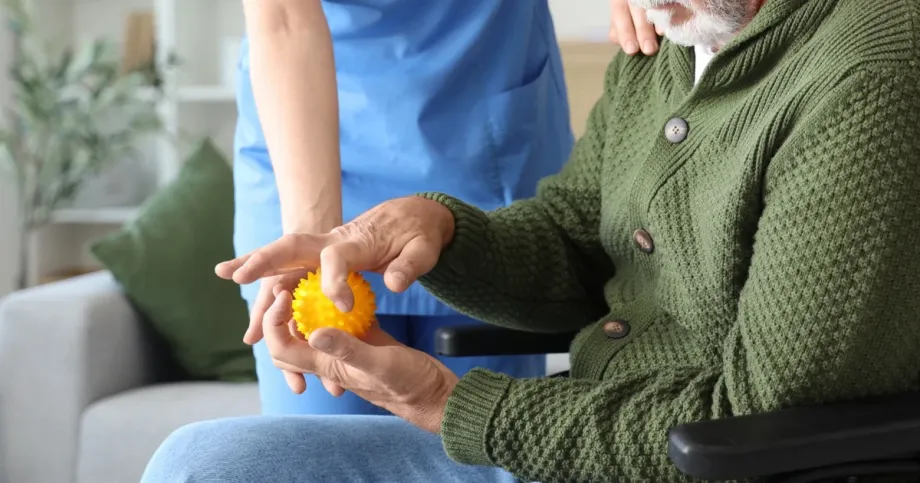
Limb paralysis can affect how a person moves, works, exercises, and handles everyday tasks. Today, treatment is about more than adapting to those changes. Advances in surgical techniques, rehabilitation, and assistive technology are creating new ways to help patients work toward greater function and independence.
The right approach depends on the cause of paralysis, the part of the body affected, the amount of remaining nerve and muscle function, and the patient's goals. For some, recovery may mean improving movement in an arm or hand. For others, it may mean managing pain, completing daily activities more independently, or returning to work or a favorite activity.
At OrthoCarolina, the Brachial Plexus and Limb Paralysis Center provides specialized care for patients with complex nerve injuries and upper extremity paralysis. Treatment can combine advanced surgical techniques with coordinated rehabilitation to help patients make the most of their recovery.
How Is Limb Paralysis Treatment Changing?
One of the biggest shifts in modern paralysis care is the emphasis on function.
Instead of focusing only on whether a particular muscle can move, care teams can look at what that movement means in everyday life. Can a patient reach for an object? Use their hand? Get dressed? Return to work? Complete personal care with less assistance?
These goals can help shape both treatment and rehabilitation.
Care may involve physicians, occupational therapists, and other rehabilitation professionals working toward the same functional goals. This multidisciplinary approach can be especially important when paralysis affects the nerves, muscles, joints, and movement patterns of an arm or hand.
Rehabilitation Is About More Than Strength
Strength is an important part of rehabilitation, but it is not the only goal.
Depending on the patient, limb paralysis rehabilitation may focus on:
- Maintaining joint flexibility and range of motion
- Improving strength in muscles that can still respond
- Retraining movement and coordination
- Managing pain
- Improving balance and mobility
- Practicing everyday activities
- Adapting tasks or the home environment
- Supporting greater independence
For patients with upper extremity paralysis, occupational therapy may focus on practical arm and hand use. That could include repeatedly practicing reaching, grasping, releasing an object, or completing a familiar daily activity.
The goal is not simply to make a muscle stronger. It is to make movement more useful.
Neuromuscular Retraining Can Support Functional Recovery
When a nerve injury disrupts communication between the nervous system and muscles, rehabilitation may include neuromuscular retraining.
This approach uses purposeful, repeated movements to help patients work on control and coordination. Therapy may focus on a specific movement while the patient practices using the available muscle function as effectively as possible.
After treatment for a complex peripheral nerve or brachial plexus injury, rehabilitation may also be an important part of learning to use restored or redirected function.
Progress can be gradual, and the therapy plan may change as nerve and muscle function changes.
Technology Is Adding New Tools to Rehabilitation
Technology is becoming another tool in the rehabilitation process for some patients with paralysis.
Depending on an individual's needs, treatment may incorporate:
- Functional electrical stimulation
- Robotic-assisted movement
- Body-weight-supported training
- Wearable movement sensors
- Virtual reality
- Assistive technology
Functional electrical stimulation (FES) uses controlled electrical impulses to activate muscles. In rehabilitation, it may be paired with purposeful movement or exercise for selected patients.
Robotic systems and body-weight-supported equipment can provide additional support while patients practice movement. Wearable sensors may provide information about movement and activity, while virtual reality can make repetitive exercises more interactive and provide visual feedback.
These technologies do not replace physical or occupational therapy. They can give therapists additional tools to support repetition, movement, and feedback when appropriate.
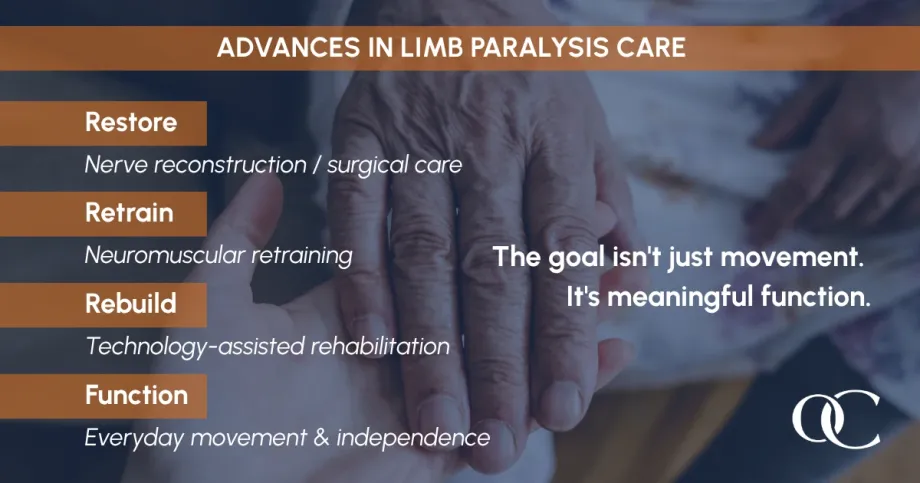
Surgical Advances and Rehabilitation Work Together
For some patients with severe peripheral nerve or brachial plexus injuries, surgical reconstruction may create an opportunity to restore nerve signals to muscles that have lost function.
Procedures such as nerve transfers, nerve grafting, tendon transfers, and free functional muscle transfers may be considered for select patients. The appropriate approach depends on the injury and the movement the care team is trying to restore.
Rehabilitation remains an important part of the process after surgery. Patients may need to practice movement, build strength, improve coordination, and learn how to incorporate new or restored function into everyday activities.
This is one reason specialized care can be valuable for complex upper extremity paralysis. Surgical and rehabilitation plans can be developed around the same functional goals.
Recovery Is About Meaningful Function
Recovery from paralysis does not always follow a straight line. Different types of movement or sensation may change at different times, and progress can vary from one person to another.
For some patients, meaningful progress may mean regaining significant movement. For others, it may mean gaining enough function to complete a specific activity more independently.
That could mean:
- Reaching for an object
- Gripping a cup
- Using a computer
- Getting dressed
- Returning to work
- Participating in a favorite hobby
These goals can help keep rehabilitation focused on what matters most to the individual.
Specialized Care for Limb Paralysis at OrthoCarolina
The Brachial Plexus and Limb Paralysis Center at OrthoCarolina provides specialized care for complex nerve injuries, peripheral nerve damage, and upper extremity paralysis.
The center brings together advanced surgical techniques, microsurgical approaches, and coordinated rehabilitation to help patients work toward improved function. Care may include nerve reconstruction, tendon transfers, and other treatment options when appropriate.
For patients dealing with limb paralysis, significant arm weakness, or a complex nerve injury, a specialized evaluation can help identify potential treatment and rehabilitation options.
Take the Next Step With OrthoCarolina
Limb paralysis can make everyday activities more challenging, but treatment does not have to focus only on what has been lost. Today's approaches give patients and care teams more tools to work toward meaningful function and greater independence.
If you are dealing with limb paralysis, significant arm weakness, or a complex nerve injury, schedule an appointment with OrthoCarolina online in just a few clicks.
Frequently Asked Questions
What are the latest advances in limb paralysis treatment?
Advances include nerve reconstruction, functional electrical stimulation, robotic-assisted rehabilitation, wearable technology, and other movement-support tools. Brain-computer interfaces and neural prosthetics are also being studied.
Can rehabilitation improve function after limb paralysis?
Rehabilitation can help patients maintain mobility, improve strength where possible, retrain movement and coordination, manage pain, and adapt everyday activities. The approach depends on the cause of paralysis and the patient's individual goals.
What technologies are used in paralysis rehabilitation?
Depending on the patient, rehabilitation may incorporate functional electrical stimulation, robotic-assisted movement, body-weight-supported training, wearable sensors, virtual reality, and other assistive technologies.
Back