


Brachial plexus injuries affect the network of nerves that connects the spinal cord to the shoulder, arm, and hand. When these nerves are stretched, compressed, torn, or pulled away from the spinal cord, they can cause symptoms ranging from burning nerve pain and numbness to significant weakness or loss of arm function.
Treatment and recovery depend on the type and severity of the nerve injury. Some brachial plexus injuries improve with time and rehabilitation, while more severe injuries may require surgery to repair or reconstruct damaged nerves. Because nerve recovery can be slow and treatment options can depend on timing, an early evaluation is important when significant weakness, numbness, or loss of function occurs after an injury.
At OrthoCarolina, our orthopedic specialists evaluate nerve, muscle, and joint function together to understand what is causing your symptoms and determine the most appropriate treatment approach.
What Is the Brachial Plexus?
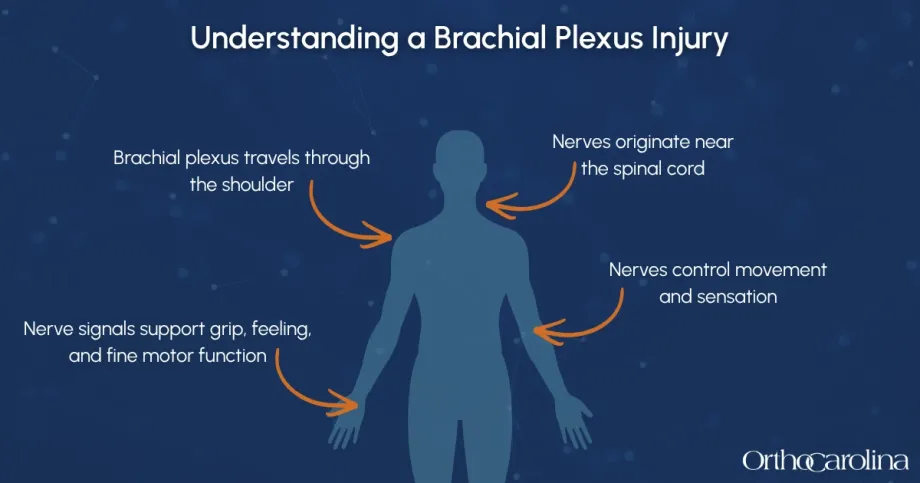
The brachial plexus is a network of nerves that begins in the neck and travels through the shoulder and into the arm and hand.
These nerves are responsible for sending signals that control movement and sensation throughout the upper extremity. Because the brachial plexus covers such a large area, an injury can affect different parts of the arm depending on which nerves are involved.
A brachial plexus injury may affect your ability to:
- Lift your shoulder or arm
- Bend or straighten your elbow
- Move your wrist or fingers
- Grip objects
- Feel touch, pressure, temperature, or pain
- Coordinate movements of your arm and hand
This is also why brachial plexus injuries can look very different from one person to another. One person may experience primarily burning or shooting pain, while another may have significant weakness or difficulty moving the arm.
What Does a Brachial Plexus Injury Feel Like?
Brachial plexus injury symptoms can vary based on the location and severity of the nerve damage.
Common symptoms include:
- Burning or stinging pain
- Sharp, shooting, or electric-like pain
- Numbness or decreased sensation
- Tingling or pins-and-needles sensations
- Weakness in the shoulder, arm, wrist, or hand
- Reduced grip strength
- Difficulty moving the arm or hand
- A heavy or limp feeling in the arm
- Loss of coordination
- Muscle wasting over time
Arm nerve pain often feels different from typical muscle soreness. Instead of a dull ache that follows physical activity, nerve pain may feel burning, shooting, electrical, or unusually sensitive to touch.
Some athletes experience a temporary “stinger” or “burner,” which can cause a brief burning or tingling sensation after an impact to the neck or shoulder. These symptoms often resolve quickly. However, repeated stingers or symptoms that persist, worsen, or involve weakness should be evaluated.
What Causes Brachial Plexus Injuries?
Brachial plexus injuries can happen when the nerves are stretched, compressed, or damaged. Traumatic injuries are among the most common causes.
Potential causes include:
- Motor vehicle or motorcycle accidents
- Falls
- Contact sports injuries
- Shoulder trauma
- Shoulder dislocations
- Fractures
- Workplace injuries
- Penetrating injuries
- Surgical complications
A severe impact can stretch the brachial plexus between the neck and shoulder. In more serious injuries, a nerve can rupture or become separated from the spinal cord.
Not every brachial plexus problem is caused by a major traumatic event. Nerve compression, inflammation, tumors, and other medical conditions can also affect the brachial plexus.
Because symptoms can overlap with problems involving the cervical spine or other nerves in the arm, determining the source of the symptoms is an important part of diagnosis.
How Severe Are Brachial Plexus Injuries?
Not all nerve injuries are the same. The severity of a brachial plexus injury can have a significant impact on treatment and recovery.
Stretch injuries
A nerve may be stretched without being completely disrupted. These injuries may improve as the nerve recovers and normal nerve signaling returns.
Nerve compression
Pressure on a nerve can interfere with its ability to send signals properly. Depending on the cause and severity, relieving the pressure may allow nerve function to improve.
Nerve rupture
A nerve can be partially or completely torn. A severely damaged nerve may not be able to recover on its own and may require surgical reconstruction.
Nerve root avulsion
In the most severe injuries, a nerve can be pulled away from the spinal cord. This type of injury generally does not heal on its own and requires specialized evaluation.
The distinction between these injuries is important because a nerve that is stretched but intact has different treatment and recovery potential than a nerve that has been completely disrupted.
How Are Brachial Plexus Injuries Diagnosed?
Diagnosing a brachial plexus injury starts with a detailed history and physical examination.
Your orthopedic specialist will want to understand how the injury occurred, when symptoms began, and how those symptoms have changed. The physical examination may include testing:
- Muscle strength
- Sensation
- Reflexes
- Range of motion
- Grip strength
- Shoulder and arm function
- Coordination
Your provider may also compare the affected arm with the opposite side to identify differences in strength or sensation.
Additional testing may be recommended depending on your symptoms and the suspected location of the injury.
Imaging
Imaging can help evaluate the bones, joints, spinal structures, and soft tissues surrounding the brachial plexus.
X-rays may identify fractures or other bone injuries. MRI can provide detailed images of nerves and surrounding soft tissues. In some cases, specialized CT imaging may be used to evaluate the nerve roots near the spinal cord.
Nerve testing
Electrodiagnostic testing, including electromyography and nerve conduction studies, can provide additional information about how the nerves and muscles are functioning.
These tests can help determine where a nerve is injured, how severe the injury may be, and whether signs of nerve recovery are developing.
The timing of nerve testing can also matter. Some changes are not immediately detectable after an injury, so your specialist may recommend testing at a specific point during your recovery or repeating testing over time.
How Do Brachial Plexus Injuries Heal?
Nerves heal much more slowly than many other tissues in the body. Recovery depends on the type and location of the injury, as well as whether the nerve remains structurally intact.
A mild injury may gradually improve as the nerve recovers. More severe injuries may require surgical treatment to restore a connection between the nerve and the muscles it controls.
One reason timing matters is that muscles need ongoing nerve signals to remain healthy and functional. If a muscle is disconnected from its nerve supply for an extended period, the potential for meaningful recovery can decrease.
That does not mean every severe brachial plexus injury requires immediate surgery. Instead, it means significant weakness or loss of function should be evaluated by a specialist early so that treatment options can be considered while they are still available.
Recovery can also be gradual. Sensation may return before strength, or some muscles may recover while others remain weak. Your care team can monitor these changes and adjust treatment as your recovery progresses.
What Are the Treatment Options for Brachial Plexus Injuries?
Treatment depends on the severity and location of the injury, the symptoms you are experiencing, and how much nerve function remains.
Treatment may include observation, rehabilitation, pain management, or surgery.
Nonsurgical Treatment
Some brachial plexus injuries can improve without surgery.
When the nerve is expected to recover, your care team may recommend physical or occupational therapy to maintain joint mobility and protect function while the nerve heals.
Rehabilitation may focus on:
- Maintaining shoulder, elbow, wrist, and finger mobility
- Preventing stiffness
- Protecting weak muscles and joints
- Maintaining strength in unaffected muscles
- Improving coordination
- Gradually strengthening muscles as nerve function returns
- Adapting daily activities during recovery
Pain management may also be part of treatment. Nerve pain does not always respond to the same approaches used for muscle or joint pain, so treatment should be tailored to the type and severity of your symptoms.
Surgical Treatment
More severe brachial plexus injuries may require surgery.
Depending on the injury, surgical options can include:
- Nerve repair: Reconnecting a nerve that has been damaged but remains repairable.
- Nerve grafting: Using a segment of another nerve to bridge a damaged area.
- Nerve transfer: Redirecting a functioning nerve or part of a nerve to restore function to a damaged nerve.
- Tendon transfer: Using a functioning tendon to help restore movement when nerve recovery is no longer possible.
- Muscle transfer: Transferring functioning muscle tissue to help restore lost movement in certain severe injuries.
The appropriate procedure depends on which nerves are affected, the extent of the damage, how long the injury has been present, and which functions are most important to restore.
This is one reason a specialized evaluation can be so important. Treatment is not simply about repairing a nerve. The larger goal is to restore as much useful arm and hand function as possible.
Why Does Timing Matter With Brachial Plexus Injuries?
One of the most important things to understand about brachial plexus injuries is that waiting to see if a severe nerve injury will improve on its own can sometimes limit future treatment options.
Nerve recovery is slow, and muscles can become increasingly difficult to reinnervate the longer they go without receiving signals from a healthy nerve.
That does not mean every patient needs surgery or that every injury is an emergency. Some stretch injuries recover well with observation and rehabilitation.
The important distinction is between monitoring an injury under the guidance of a specialist and simply ignoring persistent weakness, numbness, or loss of function.
If you have significant symptoms following trauma, an orthopedic specialist can evaluate the injury, monitor for signs of recovery, and determine whether additional testing or treatment is appropriate.
When Should You Get a Brachial Plexus Injury Checked?
You should seek medical evaluation if you develop persistent or significant arm symptoms, particularly after an injury.
Signs that warrant evaluation include:
- Arm weakness after a fall, crash, sports injury, or other trauma
- Persistent numbness or tingling
- Burning or electric-like arm pain
- Difficulty lifting or controlling the arm
- Loss of grip strength
- Difficulty bending or straightening the elbow
- Loss of wrist or finger movement
- Progressive weakness
- Visible muscle wasting
- Repeated stingers or burners that do not fully resolve
Sudden or severe weakness, loss of arm function, major trauma, or symptoms involving circulation should be evaluated promptly.
It is also important to remember that arm pain, numbness, and weakness do not automatically mean you have a brachial plexus injury. Similar symptoms can come from the cervical spine, individual peripheral nerves, the shoulder, or other conditions.
A proper evaluation is the best way to determine what is actually causing your symptoms.
What Does Recovery From a Brachial Plexus Injury Look Like?
There is no single recovery timeline for brachial plexus injuries.
Recovery depends on several factors, including:
- The type of nerve injury
- Which nerves are affected
- The location of the injury
- Whether the nerve remains intact
- The severity of the damage
- How quickly treatment begins
- The person's overall health
- Whether surgery is required
- How consistently rehabilitation is completed
Some people experience meaningful improvement with nonsurgical treatment. Others require nerve reconstruction or other procedures followed by an extended period of rehabilitation.
Because nerves recover slowly, patience is an important part of the process. Your specialist may monitor your strength, sensation, movement, and nerve function over time rather than expecting immediate changes.
The goal is not simply to determine whether a nerve is healing. It is to understand whether that recovery is translating into meaningful function in your arm and hand.
The Bottom Line on Brachial Plexus Injuries
Brachial plexus injuries can range from temporary nerve irritation to severe injuries that cause lasting weakness or loss of function. Understanding the difference is important because the type and severity of the injury influence both treatment and recovery.
Persistent burning arm pain, numbness, tingling, or weakness should not automatically be dismissed as a minor injury, especially when symptoms develop after significant trauma. An orthopedic evaluation can help determine whether the brachial plexus, cervical spine, shoulder, or another structure is responsible.
For some injuries, time and rehabilitation may be enough to support recovery. For more severe nerve damage, surgical reconstruction may be considered. The earlier a significant injury is identified, the better your care team can monitor recovery and discuss appropriate treatment options.
Get Expert Care for Brachial Plexus Injuries
Arm pain, numbness, or weakness can have many causes. If you are experiencing symptoms that are affecting your strength, sensation, or ability to use your arm, getting an accurate diagnosis is the first step toward understanding your treatment options.
OrthoCarolina's orthopedic specialists can evaluate your symptoms, identify the source of your pain or weakness, and help determine the right next step. Book an appointment easily online, or walk into a clinic near you to get your symptoms checked.
Frequently Asked Questions
Can a brachial plexus injury heal on its own?
Some mild brachial plexus injuries can improve without surgery, particularly when the nerve has been stretched but remains structurally intact. More severe injuries, including ruptured or avulsed nerves, may require surgical treatment. An evaluation can help determine the severity and expected recovery.
How long does it take to recover from a brachial plexus injury?
Recovery varies widely. Nerves heal slowly, and recovery can take months or longer depending on the type and severity of the injury. Some people recover with rehabilitation alone, while others require surgery followed by an extended rehabilitation process.
Does a brachial plexus injury always cause weakness?
No. Symptoms depend on which nerves are affected and how severe the injury is. A person may experience pain, numbness, tingling, weakness, or a combination of symptoms. Persistent or significant weakness after an injury should be evaluated.
Back