


Ergonomics and the “90-90-90 Position”: Why ‘how’ you sit is so important
Does your work require you to sit at a desk 8-10 hours a day? Do you have back, neck, arm or hand pain?
It is physically challenging on your body to sit for a long period of time. Your body needs a lot of stability and strength that comes from your core. The core is made up of deep muscles located next to the spine including the transverse abdominus and the multifidus muscles.
Research has shown that 85% of the population has back pain at some point in their lives. Back pain is the most common condition treated in physical therapy. With our computer generation, many people tend to sit all day with infrequent breaks. This type of labor can involve very intense work at a desk which may involve leaning forward while looking at the computer screen. As we get older, sometimes we lean in a bit more to stare at the screen.
Truck driving is actually the occupation with the highest incidence of back pain. The back pain may be due to extended sitting in the cab combined with vibration, and the heavy physical labor that some truck drivers perform.
When it comes to back pain proper ergonomics is important. Ergonomics is the study of work and how to adapt the workplace/job for the person. Two things can make a big difference at your job:
- Your chair
- Your posture
Let’s Talk Chairs
It is important to start with a proper adjustable height chair with good lumbar support. You need a chair with a natural inward curve to maintain lower back support. (If your chair doesn’t have one, you can buy a lumbar support for your chair that is curved and sloped for the spine.)
What is the best type of seat for your chair? A cushioned seat pan will alleviate pressure on the gluteal (buttock) muscles during sitting. The seat pan of the chair should have a waterfall effect where the edge of the pan curves away from the underside of your legs. Using a flat-seated chair pan risks impeding the blood flow in your legs. Some chairs have arms, but you should not lean on them for extended periods of time because it can cause pressure in the elbows and irritate nerves.
The back of the chair needs to come up high enough to support your shoulders. Taller people may want to consider a chair with a higher back support in order to support the shoulder area. If possible, it is nice to have a swivel chair to allow you to move or change position. Your chair will rotate instead of you having to twist or side-bend your spine. This will alleviate stress to the muscles. The ideal situation would be a chair with five wheels that allows for more stability and ease of movement. Changing your position often is very helpful for the spine.
Working on Your Seated Posture
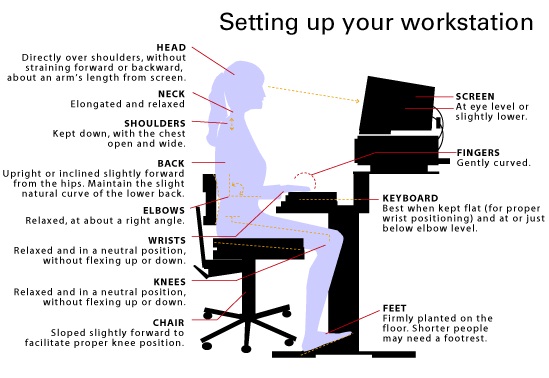
Focus on using the “90-90-90 position” while sitting at work. Your ear should be on top of the shoulder, the shoulder should be on top of the hip (for spinal alignment), and your elbow should be bent at a 90 degree angle. If your arms are winged out it can dramatically increase the tension in your neck and shoulder area. Your hips should be at a 90 degree angle as well as the knees and thighs – all 90 degrees. Your feet should rest flat on the floor. For shorter people, a footrest under the feet can help achieve the 90 degree angle. Here are some other tips:
- When you are keying at the computer, make sure your wrist is straight rather than cocked up or down in order to avoid irritation which can lead to carpal tunnel syndrome or other issues.
- The best keyboard height is usually about 25 inches from floor. Use a keyboard tray which will allow for maximum efficiency and comfort.
- An adjustable keyboard tray resting at 25 inches is ideal, but taller individuals may have to raise that height.
- The normal desk height should be 27-29 inches. It is best not to put a computer keyboard on a desk because it is too high.
- The top of the screen of a regular computer should be about an inch below eye level because as we read we read down, so your eyes fall down rather than going upward.
I also recommend getting up every 15-30 minutes. Get up out of your chair and move. Walk to the kitchen, to the printer or climb your office stairs. Just like your body needs water, movement rehydrates the discs and lubricates your joints.
Back